Data for: Assessing the Usability of a Novel Toolkit for Creating Visual Key Information Pages for Informed Consent for Research logo

Data for: Assessing the Usability of a Novel Toolkit for Creating Visual Key Information Pages for Informed Consent for Research

Project Overview

Federally required key information pages for research informed consent require a condensed summary of information to improve participant understanding, but these pages have not widely incorporated health literacy best practices. We previously developed a visual key information template based on these best practices to improve informed consent documents using qualitative methods and pilot testing (qualitative article doi: 10.1017/cts.2024.662; qualitative data doi: 10.5064/F6DDBH8U; pilot testing article doi: 10.1136/bmjopen-2024-092185). This related study conducted usability testing of this customizable one-page key information template through a think-aloud ...

Data for: COVID Diaries, State Response to COVID Vaccination Program, December 2020 to September 2021 logo

Data for: COVID Diaries, State Response to COVID Vaccination Program, December 2020 to September 2021

Project Overview

This dataset comprises 5,223 unique documents published online on the official websites of governors’ or health departments’ offices across all U.S. states in relation to the COVID-19 vaccination program. The dataset covers the timeframe from December 2020, when states began preparing for Phase 1a of the COVID-19 vaccination allocation program, to September 2021, when COVID-19 vaccines were widely available to all adults and frequently mandated. It is a collaborative effort between the Yale School of Medicine and Yale's Tobin Center for Economic Policy. Our aim is to archive publications from State Governors and Departments of Health across 50 U.S. states and ...

Data for: What Extraordinary Times Tell Us about Ordinary Ones: A Multiple Case Study of Precariously Employed Food Retail and Service Workers in Two U.S. State Contexts during the COVID-19 Pandemic logo

Data for: What Extraordinary Times Tell Us about Ordinary Ones: A Multiple Case Study of Precariously Employed Food Retail and Service Workers in Two U.S. State Contexts during the COVID-19 Pandemic

Project Overview

This project consists of a multiple case study of older, precariously employed food workers in two U.S. states (Indiana and Washington) during the COVID-19 pandemic, designed to explore the links between employment quality and social context as drivers of disease prevention. This deposit is of individual semi-structured qualitative data in the form of de-identified and generalized transcripts of the interviews conducted.

Resources

Managing Data

QDR offers a series of web pages addressing key topics in managing research data from data management planning to formatting and depositing data, all with a focus on the needs of qualitative researchers.

Discover More

Deposit Process

How do you deposit data with QDR? Learn about the steps of a data deposit, deposit fees and waivers, and typically turnaround times.

Discover More

ATI at a glance

Annotation for Transparent Inquiry

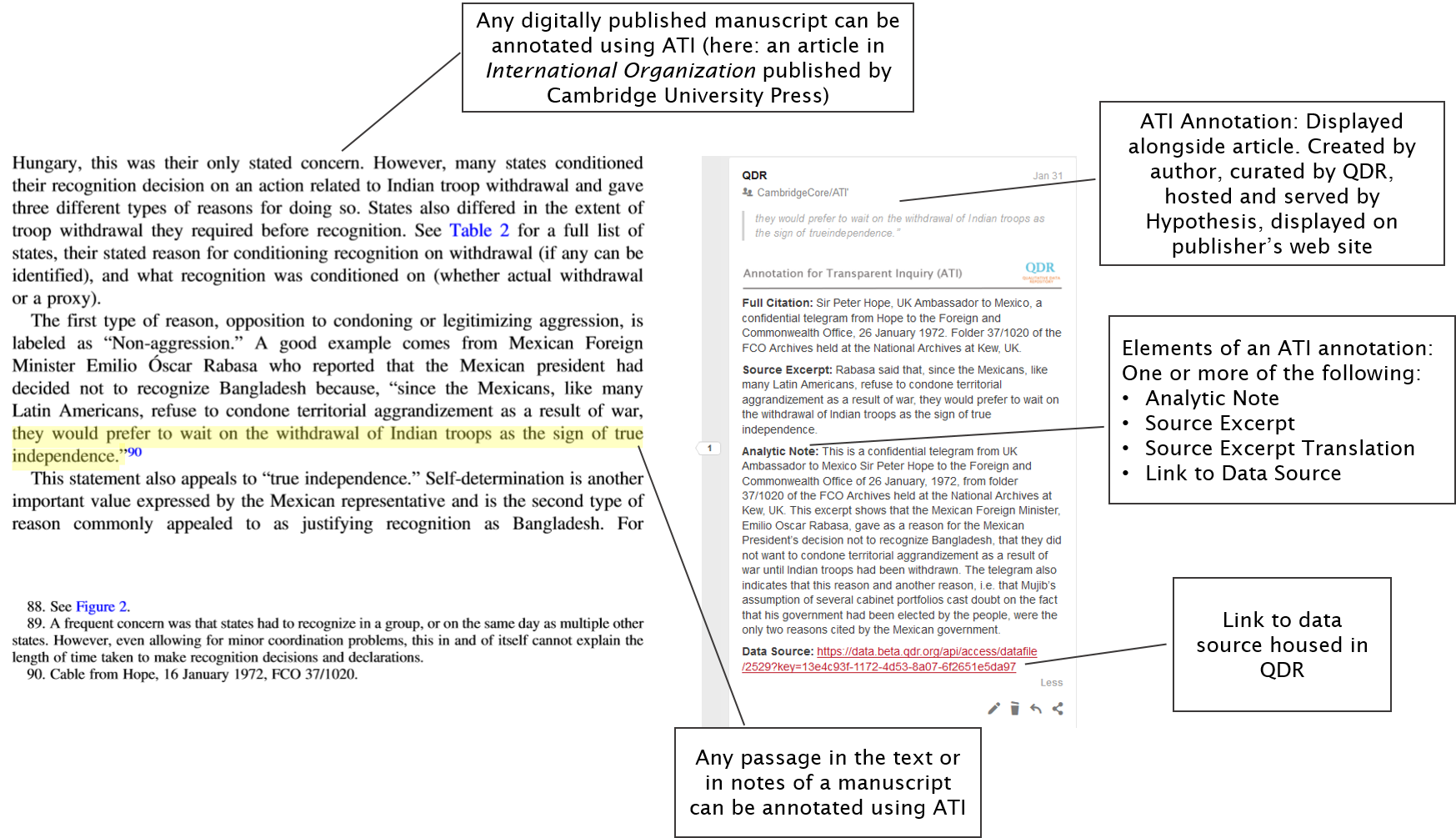
Annotation for Transparent Inquiry (ATI) facilitates transparency in qualitative research by allowing scholars to “annotate” specific passages in an article. Annotations amplify the text and, when possible, include a link to one or more data sources underlying a claim; data sources are housed in a repository.

Learn more about ATI ‣

About QDR

Sharing data and its documentation for secondary analysis

Empowering qualitative and multi-method inquiry through guidance and consultation

Providing data  and materials to enrich and enliven teaching

Developing innovative approaches for enriching publications with data and analysis

Our Mission

QDR curates, stores, preserves, publishes, and enables the download of digital data generated through qualitative and multi-method research in the social sciences. The repository develops and disseminates guidance for managing, sharing, citing, and reusing qualitative data, and contributes to the generation of common standards for doing so. QDR’s overarching goals are to make sharing qualitative data customary in the social sciences, to broaden access to social science data, and to strengthen qualitative and multi-method research.

Learn more about us ‣