DOI: https://doi.org/10.59350/w4xgx-vbc07
To mark this year’s Love Data Week, the QDR team is offering a duo of brief blog entries highlighting new features for our users and tips on how to make the most of the repository’s offerings. This is the second blog post.
Finding the right materials in QDR's growing catalog is now even faster and more precise. New and improved facets make our growing holdings easier to find, evaluate, and access. Facets are simple but smart filters which allow you to narrow down a larger set of search results to a more focused subset organized around a feature of interest. On our repository they appear on the left by default as seen here:
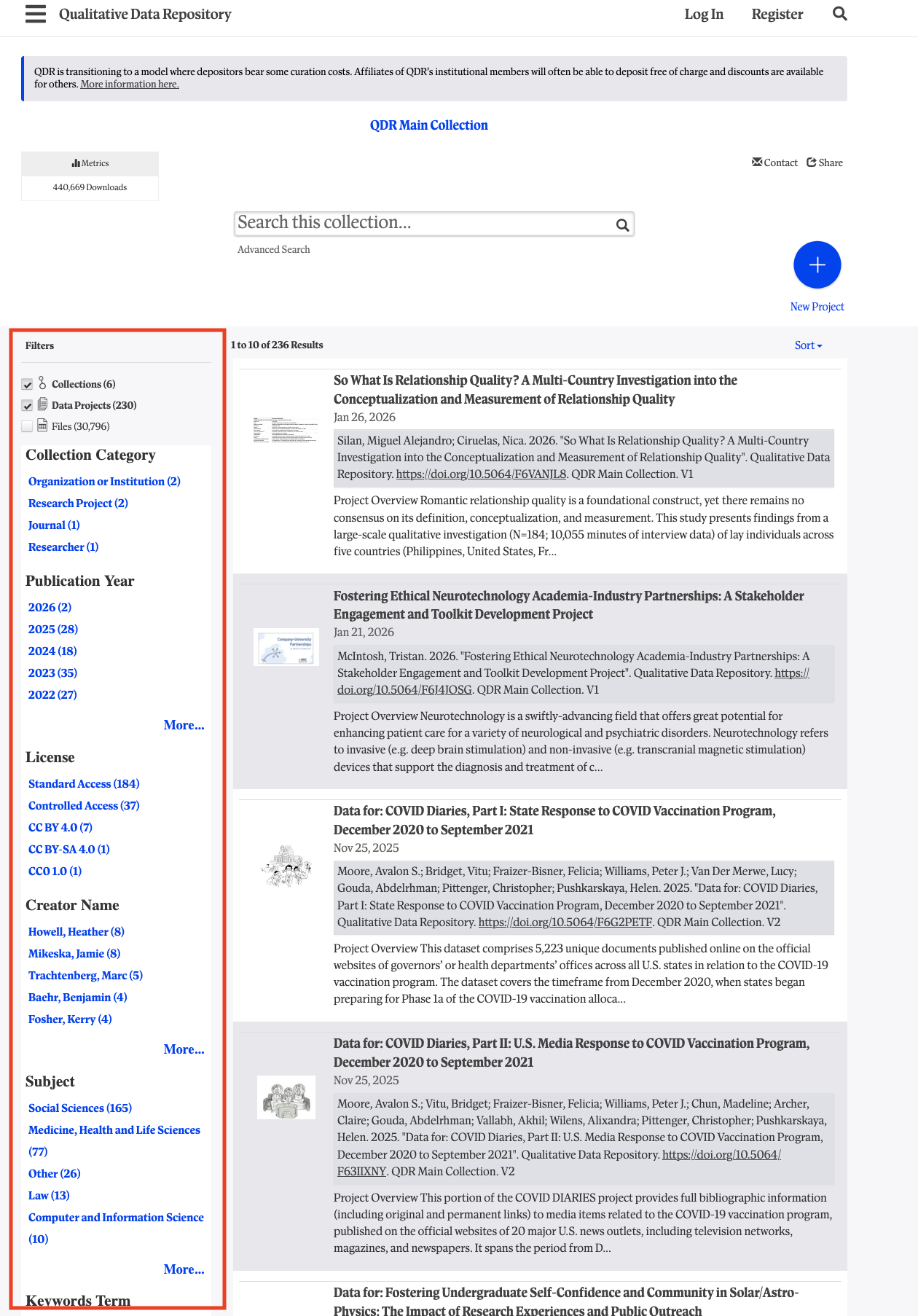
We display nine different filter options. Here we highlight three of these which we think might be most informative in locating data projects that someone might be looking for based on specific attributes.
Geographic Coverage
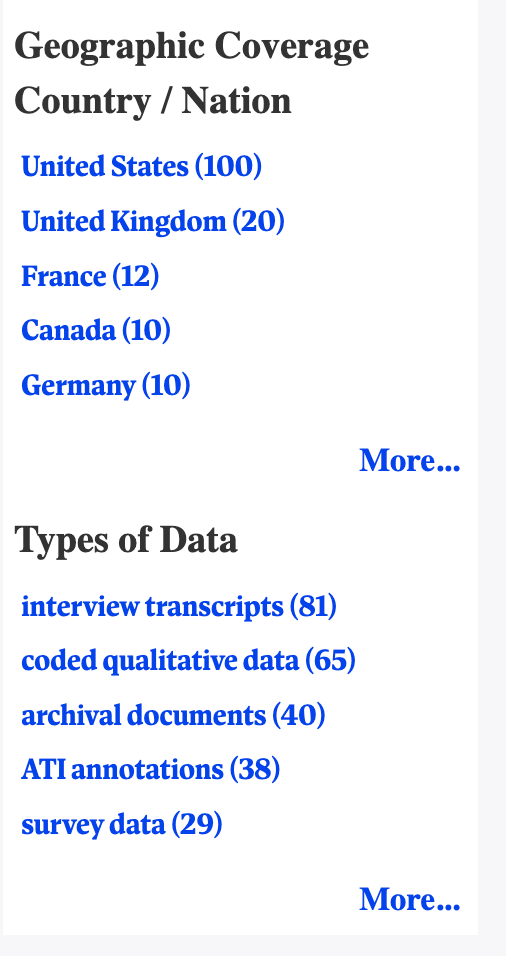
Researchers are often interested in data from sites around the world they themselves might be studying. The Geographic Coverage Country / Nation filter allows for a quick way to locate data relevant to a specific country. The top five results (in this instance, countries mentioned in the largest number of published data) are displayed by default and you can expand the full list by clicking the “More…” link below that filter. In the case of the country / nation category, data published on QDR currently cover 73 countries in total. While the US is overrepresented with mentions in 100 projects, this is changing with more and more recent deposits based on international and multi-national work.
Types of Data
The second filter that allows users to find the types of data most relevant to their secondary user purposes is the Types of Data item. The top five categories displayed show that more than one-third of the currently published data contain individual interview transcripts and close to another one-tenth, focus group transcripts. This type of substantively rich qualitative data, often appropriate for deep secondary engagement and reanalysis, constitute the “bread and butter” of what QDR publishes. Another category that is well represented, with 40 projects, and can be fruitfully mined for substantive secondary work are archival materials. On the other hand, 65 published projects contain coded qualitative data, which typically means they cannot be reanalyzed for new insights, although they are often closely related to published scholarship and enhance its transparency and comprehension. This type of project confirms that data sharing is not all or nothing, but can be done to some degree even when not planned for from the beginning of a project, still allowing researchers to meet journal and article (minimal) data availability requirements.
License
The last filter we’re choosing to highlight here is the License under which data are published. The two main licenses which QDR uses are “Standard” and “Controlled”. The decision which of these default licenses is appropriate for each deposit (and in fact, for which files within a deposit) is based largely on the specific commitments made to study participants under the informed consent used, as well as a detailed assessment made in conversation with depositors.
The vast majority of data published appears under the “Standard” data use agreement, which commits users to basic good research data reuse practices. Four critical ones called out in the QDR General Terms and Conditions of Use are:
- Users will not intentionally try to reidentify de-identified participants.
- Users will only use the data for academic (research or teaching) non-commercial purposes.
- Data used for the basis of or mentioned in further written outputs must be cited properly and fully.
- Users cannot make additional digital or paper copies and disseminate to others outside of the QDR system.
That means that any registered and logged in QDR user who has agreed to those basic terms of use of the repository can access data files published under “Standard Access” directly when logged in.
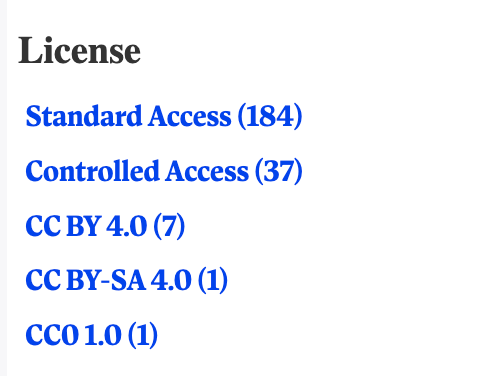
About 15 percent of the published deposits are published under “Controlled Access,” which means that they do have some level of further restriction. A common set of requirements, for example, is confirmed academic affiliation, a research plan and evidence of human participant training or experience. The specific conditions differ based on the potential risks assessed and the requirements set by the original depositors, but typically they can be met by most bona fide researchers who have identified a given project as relevant to their own work. In many – though not all — cases that makes controlled access data not the best choice for pedagogical purposes. Using the License facet can save an instructor looking for training data, for example, a lot of time and effort.
We hope you find this brief introduction to the new facet-based search on QDR helpful and that you will explore it on your own the next time you are looking through our catalog!